Fear of unfamiliar environment
The Curious Incident of the Dog in the Night-TimeFear of unfamiliar places governs how Christopher can move through the world: travel is not simply distance but a series of decisions and demands he must make manageable. On his journey from Swindon to London, the fear is intensified by the knowledge that his father is nearby, and eased—though never erased—by turning movement into a route he can follow.
Fear and Distance
Christopher describes two fears operating at once: being far from somewhere familiar and being near his father. He understands them as inversely related, so that as he moves farther from home and his father, one fear rises while the other falls, leaving his total fear approximately constant. The formula gives a precise, almost mathematical form to a conflict that otherwise has no safe option. Setting out does not mean becoming unafraid; it means choosing which fear to face.
That calculation directs him toward London, where he believes he must live with his mother. He makes the journey seem possible by breaking it into known procedures: consult the timetable, go to the station, buy a ticket, check the departure board, find the platform, and board the train. His familiarity with trains comes from his train set, so a remembered miniature system becomes a guide to a much larger and less predictable world.
Stations as Obstacles
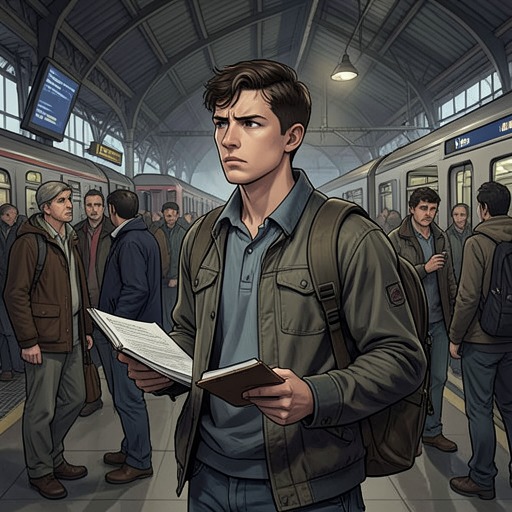
The station in Swindon does not resemble the model station in Christopher’s train set. Its tunnel, stairs, shops, and crowds make it difficult to orient himself; he admits that fear has made his remembered map approximate. The tunnel feels perilous, and the noise, echoes, and surrounding activity crowd out his ability to plan. He tries to block the sound and proceeds by concentrating on a sign, then finds a corner table where he can sit, close his eyes, and hold Toby.
Christopher relies on small, concrete actions to regain enough control to continue. He feeds Toby two pellets, grips his Swiss Army knife, and solves a maths problem when he cannot organize his thoughts. These are not shortcuts past fear: the crowded station remains overwhelming. They are ways to create a narrow task within it, allowing him to wait and then resume the journey.
Navigating London
In London, signs and route choices turn unfamiliar space into a sequence of instructions. Christopher follows directions toward Willesden Junction on the Bakerloo Line, locating the destination on a sign and taking the left-hand passage. He keeps to the left in a divided tunnel, follows arrows, and uses the map’s orientation to choose the northbound platform. When the escalator and nearby passengers make the passage difficult, he holds the moving rail and restrains himself from striking anyone, remembering the police caution.
He also uses mental images to manage the environment. Before descending into the Underground, he tells himself that he can manage, pictures people as cows in a field, and imagines a red line on the floor for his eyes to follow. These devices reduce the demands of a large, crowded space to a direction and a path. They do not make the Underground familiar, but they give him a way to cross it without losing his bearings.
Home, Sensory Overload, and Persistence
The journey’s emotional stakes become explicit at the station. Christopher wishes he could return home, then corrects himself: because his father is there and has lied and killed Wellington, he no longer considers that house home. He identifies his destination instead as 451c Chapter Road, London NW2 5NG. The change makes the unfamiliar city both frightening and necessary: it is where he believes his home with his mother now is.
At the Underground station, repeated trains and crowds overwhelm him. He shakes, closes his eyes, sweats, feels sick, and struggles to breathe; he describes the experience through the image of a computer that has crashed and cannot be switched off. He can only sit and wait for the noise and crowding to recede. Later, outside Willesden Junction, darkness and bright lights again make him feel sick. Keeping his eyelids nearly closed, he follows the shapes of the roads until he can identify Station Approach and Oak Lane. The contrast between these episodes and his careful navigation shows that persistence does not depend on fear disappearing. Christopher reaches his destination by narrowing attention, relying on signs and remembered rules, and continuing through conditions that remain distressing.